
bellow forth
bellow forth
restor(y)ing soil


ABOUT
Bellow Forth, (2023-ongoing) is a community, eco-social art project focused on restor(y)ing soil health and ecosystem resilience through ecological art, storytelling, community collaboration, education, and ecosystem soil science in wildfire-impacted lands/communities in northern New Mexico. This project addresses essential ecosystem regeneration necessitated by the 2022 Calf Canyon and Hermit’s Peak fires, the largest wildfires in New Mexico’s state history. The super-hot fires burned nearly 350,000 acres throughout the traditional homelands of Tewa and Jicarilla Apache Peoples, historical Land Grant communities, ranches, farmlands, homes, and mixed conifer and deciduous forest systems.

The complexities of these histories, combined with three distinct waves of settler colonialism in this territory, requires emplaced and community-led responses towards contemporary environmental restoration efforts. Further, the environmental impacts from the fires are significant and will be long lasting, demanding considerate and novel recovery efforts. Bellow Forth ideates and practices alternative solutions to ecosystem repair guided by our ethos of restor(y)ing; this term is not as a word, or a symbol, it is a strategy—wherein cultural practices of meaning-making (storying) are symmetrical to and inseparable from ecosystem health and multispecies wellbeing. Diverse community stories and memories of place are the nutrients and nucleus of this project, feeding the scientific experimentation and steering its aesthetic development.
Through transdisciplinary practice Bellow Forth centers community engagement and participation and fosters the expansion of ecological art practices with theory/practice grounded in Traditional Ecological Knowledge (TEK) and the growth of situated, regenerative, creative practices. By refusing to reinforce systems of harm dominant within western scientific ecosystem science, Bellow Forth carries potential to establish precedence for Indigenous-led and community-centered ecosystem science along with building long-term capacity for climate-adaptive ecologies. We ask questions like, who does the science serve? How is the community involved? Whose land is being manipulated and have those Peoples or beings been consulted? Are their needs prioritized? Bellow Forth provides substantial opportunity to practice these questions, consider and apply their answers, and visually demonstrate why listening, caring, and prioritizing relationality must be taken seriously with/in the exigencies of the climate crisis.
Materials + methodologies+ field experiment
The central aesthetic artwork is simultaneously the “materials and methods” for the Field Experiment and concurrent research into the role native soil microorganisms play in post-fire ecosystem recovery. Materially, this work combines naturally dyed, embroidered textiles with native soil fungi, microorganisms, and seeds. The in-process textiles are called Community Story Quilts and are embroidered with memories and stories-of-place from those impacted by the fires. The story quilt was inspired by the poem, “Catalog of Unabashed Gratitude” by Ross Gay, which catalogs Gay’s experiences of place, life, family, and love that he wants to thank, acknowledge, and praise. The poem
begins with a recounting of a dream where he is called by a robin to “bellow forth” a long list of what he’s grateful for as an authentic gesture for loving and singing for, “...what every second goes away.” The Community Story Quilts aim to create a similar, localized catalog. The ultimate intention for the artwork is application in the Field Experiment where portions will be buried with native microorganisms and native seeds.

Bellow Forth has been made possible with support from, a 2026 Monument Lab: Re:Generation Grant, and a 2022 Anonymous Was a Woman Grant in partnership with The New York Foundation for the Arts.

Photo by Dylan McLaughlinWildfires
On April 6, 2022 a wildfire started near Hermit’s Peak by the U.S. Forest Service who lost control of a prescribed burn due to extreme high winds. The Hermit’s Peak wildfire merged with the Calf Canyon wildfire on April 22, once again, due to extreme wind conditions. The fires forced 15,500 New Mexicans to evacuate their homes, land, animals and lives. Between 1,000-1,500 people did not have anything to return to as the fires consumed their dwellings, farm lands and memories.
The conditions for this extreme event have been brewing for years due to climate change and impacts of colonization. The spring of 2022 was one of the hottest in recorded history in New Mexico and the American Southwest has been suffering from a mega-drought since 2000. These factors combined with lack of Indigenous fire management for years created a combustible situation.
In some areas the fires burned so hot that roots incinerated underground, and fragile soil communities were severely damaged and/or completely eradicated.
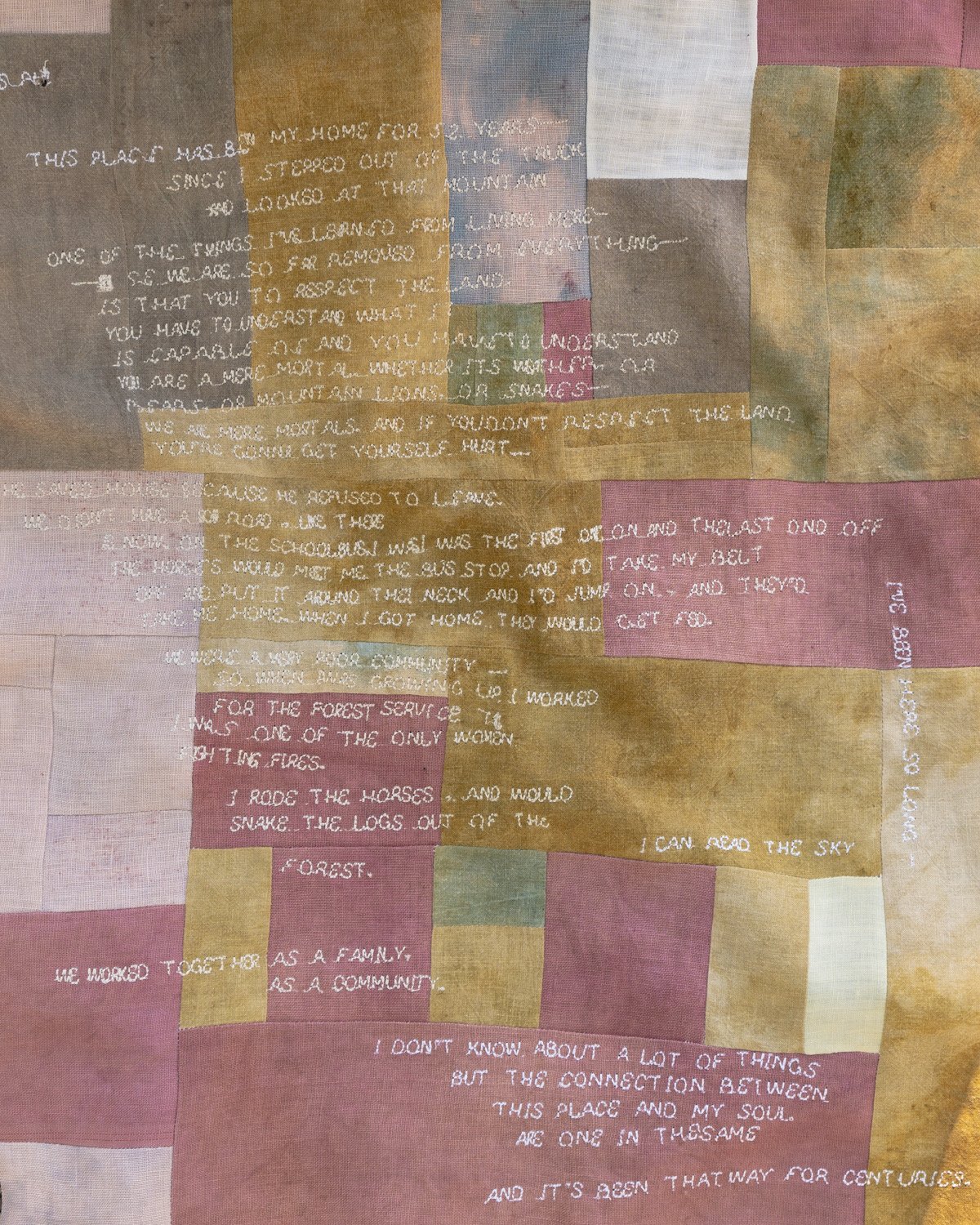
COMMUNITY + STORIES
We have been working with impacted residents since January 2023 to collect and archive their stories, experiences and relationships to the land before and after the wildfires. In exchange for sharing their stories, folks have been provided with home-cooked meals, resources, donations, and assistance with labor.
Their stories will come together to create a place-based catalog of gratitude to resonate as a reminder of what we have, what we have lost, and what we can dream. The localized catalog is being embroidered onto a story quilt, an artwork which will be buried and used in an upcoming (2024) field experiment (see science). The story quilt offers stories and assets from the human world, back to the soil food web. In this way community words will directly feed fungi and other microbes that consume the textile during its decay. This is how we believe we can both restore/restory the ground.

environmental and social impacts
The project addresses reciprocal restoration (Robin Wall Kimmerer) and interspecies relationships through Indigenous-led collaboration and soil science based in Traditional Ecological Knowledge. TEK invites us to consider the implications of multispecies connection when conducting scientific experiments and urges us to repair broken relationships to land through acts of reciprocity as well as to return land back to their original peoples and caretakers. To acknowledge our connection to ecologically complex soil systems, this community-driven artwork centers reciprocity, Land Back and mending broken relationships as the key components of repair.